
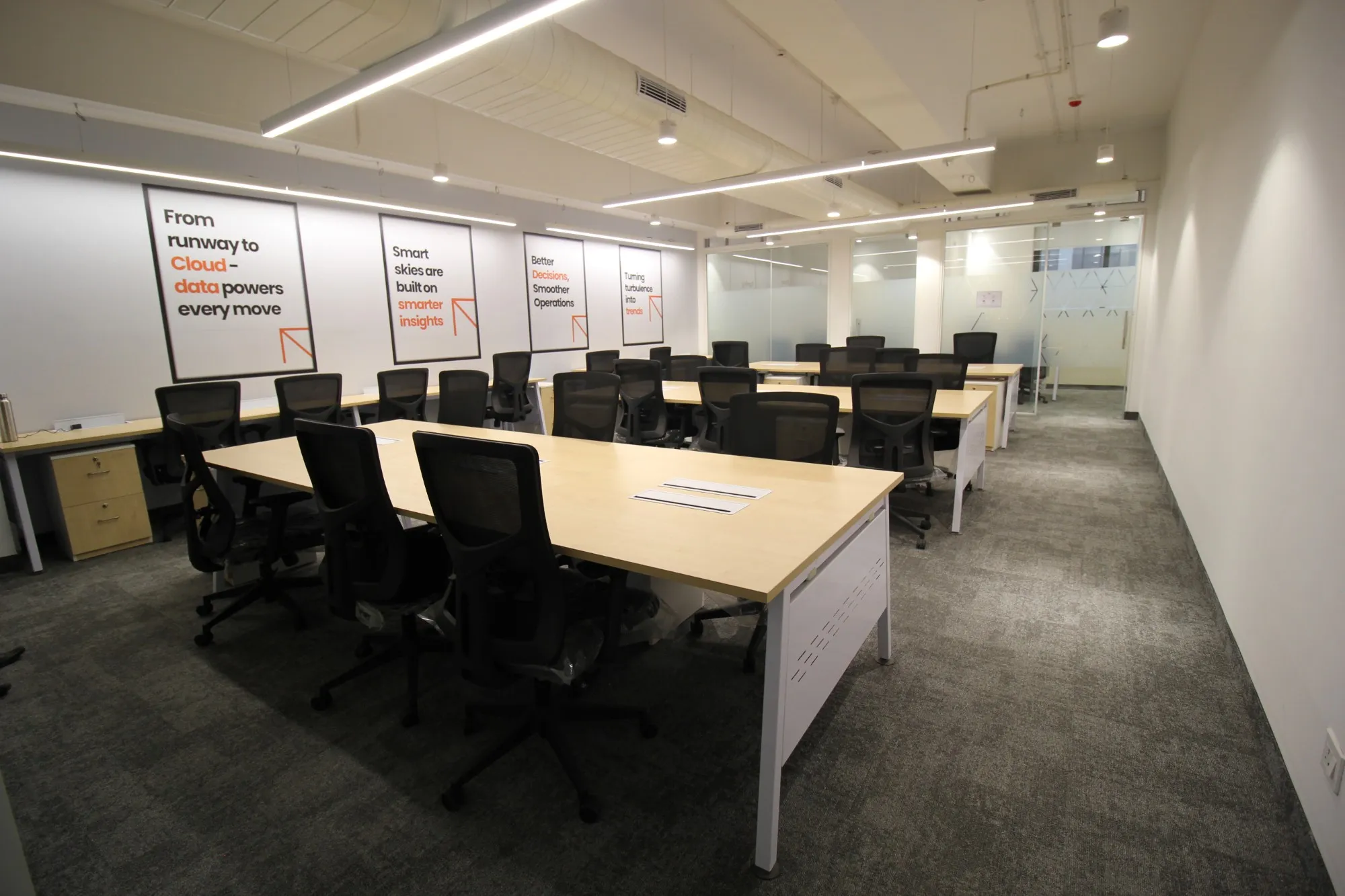
Private Cabin Office Space in Gurgaon: Evaluating Acoustic Privacy, Network Segregation and Access Controls for Enterprise Teams
A private cabin provides a physical boundary. Whether it provides sufficient confidentiality depends on how the room is constructed, how its technology is configured and who can enter it.
For enterprise teams handling customer information, financial reporting, employee matters or commercially sensitive discussions, these distinctions affect suitability. A lockable door does not establish speech privacy. A dedicated Wi-Fi name does not demonstrate network isolation. A reception desk does not establish controlled access to the tenant area.
Selecting private cabin office space in Gurgaon therefore requires an assessment of connected controls: what can be overheard, what can communicate across the network and who can reach sensitive spaces.
Define the Confidentiality Requirement Before Selecting a Cabin#
Start with the activities the team will perform. Routine collaboration, employment discussions, legal negotiations and financial decision-making carry different confidentiality requirements.
Classify the information, likely exposure routes and consequences of disclosure. Determine whether sensitive conversations occur occasionally in a separate meeting room or throughout the working day.
This establishes whether the requirement is a private team cabin, an enclosed suite with dedicated meeting facilities or a more extensively separated office.
| Control area | Enterprise question | Evidence required |
|---|---|---|
| Acoustic privacy | Can speech be understood outside the intended room? | Field assessment under representative conditions |
| Visual privacy | Are screens, documents or whiteboards visible externally? | Sightline inspection from corridors and adjacent areas |
| Network segregation | Can other tenants or guests reach enterprise devices? | Architecture review and authorised isolation testing |
| Physical access | Who can enter, approve access and revoke credentials? | Permission matrix, access records and process demonstrations |
| Operational accountability | Who investigates failures and implements changes? | Contracted responsibilities and escalation procedures |
Define these requirements before comparing proposals. Otherwise, the assessment risks treating materially different privacy provisions as equivalent.
Acoustic Privacy: Test Speech Transmission Across the Whole Room#
Sound absorption and sound isolation solve different problems. Absorptive finishes can reduce reverberation inside a cabin without preventing speech from reaching neighbouring spaces.
Inspect the complete construction: partitions, glazing, doors, seals, ceiling voids, service penetrations and ventilation paths. Sound can bypass a partition through these adjoining elements.
A component’s laboratory rating does not establish the privacy achieved by the finished room. Door installation, junction details and surrounding background sound all affect actual performance.
ASTM’s closed-room speech privacy test method provides a reference for objective assessment. A qualified acoustician can determine an appropriate approach and acceptance criteria for the intended activities.
Test representative speaking levels and listening positions in corridors, adjacent cabins and shared areas. Include quieter operating periods, when speech may become easier to understand outside the room.
For highly sensitive discussions, require a written assessment. An informal listening check is useful for screening but should not substitute for specialist verification.
Private Office Networks: Verify Isolation Beyond the Wi-Fi Name#
A dedicated network name can improve administration while leaving underlying isolation unclear. Ask how tenant, guest, building-management and connected-device traffic are separated.
Review the architecture with enterprise IT. Establish firewall ownership, routing rules, wireless configuration, administrative privileges and whether wired ports receive equivalent protection.
VLAN separation can form part of the design, but its effectiveness depends on configuration and enforcement. Request authorised tests confirming that guest or neighbouring tenant networks cannot access enterprise resources.
Network separation also does not replace identity and device security. NIST’s zero trust guidance rejects implicit trust based solely on physical or network location. Enterprise applications should retain appropriate authentication, authorisation and device controls even inside a private office.
Clarify whether enterprise-managed equipment can be installed, how changes are approved and who retains configuration records. Business continuity arrangements should preserve security controls when connectivity fails over.
Access Controls: Examine Permissions Throughout the Lifecycle#
Access assessment should extend from the building entrance to the cabin, equipment cabinets and document-storage areas.
Create a permission matrix covering employees, visitors, contractors, cleaning personnel, maintenance teams and emergency responders. Define who approves each category and how temporary permissions expire.
Test credential revocation against the organisation’s departure process. Any delay between an approved removal request and actual access withdrawal creates an exposure window that should be understood and controlled.
Review lost-card handling, visitor escorting, master-key management and after-hours entry. Establish whether provider personnel can enter unannounced and how routine access is recorded.
Emergency arrangements must preserve safe evacuation and emergency response. Security requirements should be coordinated with the building’s life-safety provisions.
Access records also need governance. Confirm who may retrieve them, how requests are authorised and how long records remain available under the agreed policy.
Assess Shared Services as Part of the Privacy Boundary#
Privacy can be undermined outside the cabin.
Shared printers may expose documents; meeting-room displays may retain session information; whiteboards may remain visible after meetings. Cleaning and maintenance activity can introduce additional access to sensitive materials.
Establish secure printing, storage, disposal and room-reset procedures. Review the placement of cameras and their fields of view around confidential work areas.
Consider demand as well as control quality. Calculate confidential-call demand from expected call frequency, duration and concurrency. Compare it with usable room availability after accounting for booking conflicts and turnaround time.
This assessment can reveal why a private cabin with occasional access to shared rooms is unsuitable for continuously sensitive work.
When evaluating private office space in Gurgaon, compare the delivered operating arrangement rather than the desk count alone.
Compare Location Proposals Using Consistent Acceptance Criteria#
Apply the same privacy specification to shortlisted MG Road offices, Udyog Vihar office space and Sohna Road offices. Do not assume that location or workspace category determines security performance.
Separate mandatory controls from preferences. A failure to meet an essential confidentiality requirement should remain unresolved until corrected or explicitly accepted by the accountable enterprise owner.
Before handover, record acoustic findings, network test results, access permissions and operating procedures. Assign ownership for configuration changes, incident investigation and corrective work.
Identify any improvements required before occupation, including partitions, enterprise networking, dedicated meeting facilities and access-control changes. Define their specifications, delivery responsibilities and acceptance evidence.
Onward’s Gurgaon page advises buyers to confirm location-specific configurations and service conditions. Privacy features and enterprise controls should likewise be verified for the proposed premises.
A brief to Onward Workspaces should describe sensitive activities, technology requirements, access expectations and anticipated growth. This gives both parties a concrete basis for assessing whether the proposed cabin can support the team’s work.
Frequently Asked Questions#
Does a private cabin guarantee confidential conversations?#
No. Speech privacy depends on the finished construction, adjoining spaces and operating conditions. Assess performance against the intended conversations.
Is dedicated Wi-Fi sufficient for enterprise network segregation?#
No. Verify routing, firewall policies, administrative access and isolation between enterprise, guest and other tenant networks.
What access controls should an enterprise request?#
Define authorised users, visitor procedures, credential revocation, provider access, master-key management and access-record availability.
How should a private cabin be approved before occupation?#
Complete acoustic, network and access-control reviews against agreed criteria. Document outstanding issues, corrective actions and accountable acceptance.